Friday, January 29, 2010

Batwoman and the Art of J.H. Williams III

A few months ago I wrote about the new Batwoman story featured in Detective Comics and about the stunning artwork by J. H. Williams III.  In Detective, Williams has been consistently creating amazing double-page spreads, finding new and unusual ways to play with the medium, to create visuals that both enhance and complement the story. 

There's a wonderful essay about Williams' evolution as an artist at The Savage Critic(s).  I highly recommend reading it.  There, Jog, the author of the piece, nicely describes Williams' current work with Batwoman:

"Williams' art tells a story in tandem with but also independent of [Greg] Rucka's words. It's free to run ahead of the plot, giving away secrets or even undercutting the dialogue for a deeper total effect. To say that Williams' art is merely good-looking or well-designed is to deny how truly unique it is, not so much inhabiting narrative space as invading it[.]"
I couldn't agree more. I love this art and I've often wondered, while reading Detective Comics, if original pieces would ever be available for sale.  Turns out, Williams sells many of pages on his blog

So, I couldn't resist.  After raising a little money through eBay, I purchased one of my favorite double page spreads, the "Yin/Yang" image of Batwoman versus her arch nemesis, Alice, from Detective Comics #857 (click to enlarge):


There's a wonderful symmetry to this piece, beyond the contrasting figures of Batwoman on top and Alice on bottom.  Notice, first, how the two capes extend to create three unique panels on each side of the picture.  Batwoman's cape creates jagged, sharp panels; Alice's produces soft, dreamy ones.  The shapes of these panels have, throughout earlier issues of the story, reflected the natures of both women: Batwoman is a character of action and discipline; Alice is a figure of violence and insanity.  Here, on one page, they are presented in direct contrast to one another. 

The symmetry of the panels extends to their contents, as well.  Alice dominates on the left (in Batwoman's panels).  She points her gun at an alarmed Batwoman (panel 1).  She shoots until her bullets are gone (panel 2).  Under fire, Batwoman crouches to protect herself (panel 3).  Then, as the flow of the story moves to the right, the action shifts.  Now, Batwoman dominates (in Alice's panels):  She prepares to attack while Alice turns to flee (panel 4).  She fires her gun (here, it is not a weapon of death, but a tool to attempt capture) (panel 5).  Finally, she pursues a fleeing Alice (panel 6).  

Each panel on the spread is distinctly complemented by one on the opposite side.  Beautiful.

I love this page: It represents a significant moment in the Batwoman/Alice arc; a critical piece of a larger whole. And yet it also manages to stand on its own.  Yes, there is much that takes place before and after these two pages, but, even without the rest of the story, you can sense the larger narrative condensed here in one single sequence.

Williams and writer, Greg Rucka, have done some great work in Detective Comics.  In fact, their Batwoman story has been so popular, the character will soon have a title of her own.  If you're looking for a good super-hero story with superior art, I highly recommend you check it out.

Wednesday, January 20, 2010

Twenty Years Ago This Month . . .

I first heard about Twin Peaks twenty years ago this month.  It was January 11, 1990, to be exact.  I had purchased a copy of the Dallas Morning News and on the front page of the Arts section was a TV column by critic, Ed Bark.  The title was: "ABC aims high with Twin Peaks."  Bark has just attended a mid-season screening of the Twin Peaks pilot in Los Angeles and was, to put it mildly, blown away.  Here's what he had to say:

"The two hour Twin Peaks movie, populated by an ensemble cast of 16 is the first TV masterpiece of the '90s and the best drama to come our way since Hill Street [Blues] floored critics and reviewers in January 1981. Dark, deceptive, visual, and, of course, quirky, it spellbinds from the very first minute -- make that the first second."

Well, I was excited.  Ed Bark was describing something magnificent and new, something startling and unique, something not-to-be-missed.  I knew I had to see Twin Peaks.  You see, I was always a fan of good TV and two decades ago good TV--and by that I mean something intelligent, complex and challenging--was a rarity.  The best television series to date had been St. Elsewhere.  There was also Hill Street Blues and the early episodes of Miami Vice.  But really, there was very little that made you sit up and take notice. 

Clearly something special was on the way.  Ed Bark ended his column by saying, "Much more will be written about Twin Peaks before it emboldens prime time as no series since Hill Street.  Circle March [the tentative broadcast month for the pilot] on your calendar and savor the prospect of further details."  Well, in a figurative sense, I did "circle the month." I took Bark's column home and placed it prominently on my desk.  I was not going to forget Twin Peaks

And I didn't.  I watched (and videotaped) the pilot episode when it premiered on April 8, 1990.  Then I watched it again the next day.  Like Ed Bark, I was bowled over.  It was the greatest thing I'd ever seen on TV. (Still is, actually.)  And Bark was right; much more was written about Twin Peaks (albeit after it aired).  In fact, much of that writing appeared in the pages of Wrapped In Plastic, produced by Craig Miller and myself. 

Not surprisingly, I'm still writing about Twin Peaks today.  And I hope in 2010 to write about it a little bit more.  Make no mistake; this blog will still be home to reviews of all sorts of books, comics, TV, films and other assorted stuff that sparks my interest.  But in this twentieth anniversary year of Twin Peaks I think I have a few fun things about Peaks to share.

Anyway, that's the story of how I first heard about Twin Peaks

So tell me, when did you first hear about it?

Wednesday, January 6, 2010

Frank Silva

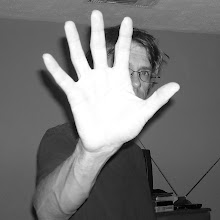
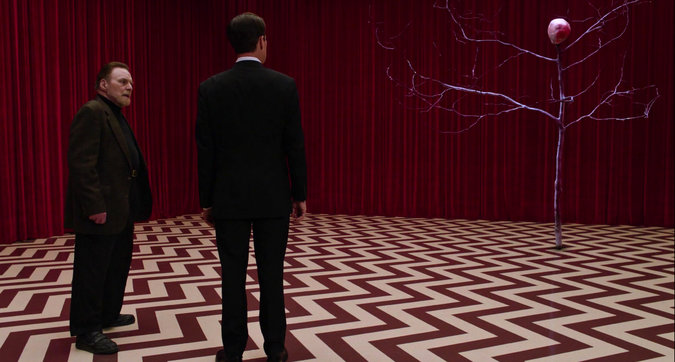
I've had a request to see some pictures of Frank Silva, the actor who played Killer Bob in Twin Peaks and Fire Walk With Me.  I took these pictures of Silva when I met him in 1993 at the annual Twin Peaks festival in Snoqualmie Falls, Issaquah and North Bend, WA.  Craig Miller and I had the opportunity to interview Silva at length and we published this interview in Wrapped In Plastic 8.  It was one of the few interviews Silva did and certainly the most extensive.


Silva was a gentle, friendly, soft-spoken man.  He was quite approachable and seemed bemused, if not slightly overwhelmed, by all the attention he was given at the festival. 


I'll never forget when I first saw him.  It was Friday night and the festival banquet at the Issaquah Holiday Inn had begun. People were sitting and eating, eyes focused on a table at the front of the room where guests Al Strobel (Mike, the one-armed man) and Jan D'Arcy (Sylvia Horne) and others were seated. Rumor was that Frank was coming but that he was running late.  Would he get there in time for the banquet?  No one knew.


I was fortunate to be sitting at the front of the room where I could see the entrance.  We had finished dinner and had listened to various speakers and it seemed like the banquet might be winding down.  Then I saw Frank Silva appear.  The response in the room was electric.  The man who played Bob was here! 


Silva took the podium and recounted us with great tales from the set of Twin Peaks and Fire Walk With Me.  It was surreal.  I was sitting a few feet from him and was instantly captivated by the man who played the forceful, frightening and indelible Bob.  But nothing could compare to the moment when Frank gave us a live performance of Bob:  He bent his head back and laughed/screamed.  He went all out.  It was a roar!  It was piercing!  It sent shivers down my spine!


The next day, Frank was due to appear at another Festival event in Snoqualmie Falls.  He had missed his ride from Issaquah and my wife and I offered to give him a lift.  For the next half-hour we had Frank Silva chatting away in our car, commenting on the time he spent in the area during the filming of the Twin Peaks pilot and Fire Walk With Me.  He pointed out places where they shot. He told us about working with David Lynch. He seemed to be truly enjoying himself.


We said good-bye to Frank Silva later that day.  We hoped he might return to future Twin Peaks festivals, but it was not be.  His visit in 1993 was his first and last.  Frank Silva died on September 13, 1995. While many Twin Peaks fans would never get the chance to meet Frank and see, for themselves, what a kind and caring man he was, they will always be able to look at his stupendous, visceral performance in the series and the film.  Frank Silva will forever be the chilling, inexorable BOB.


Thursday, December 24, 2009

My Favorite Songs of 2009

A quick entry for the holidays! 

I'm no music critic but I know what I like!  These are my favorite songs for 2009.  I'll leave it to others to write about their merits (or lack thereof . . .):

"While You Wait For The Others" – Grizzly Bear, Veckatimest

"Cannibal Resource" – Dirty Projectors, Bitte Orca

"Hey, Snow White" – New Pornographers, Dark Was The Night

"1901" – Phoenix, Wolfgang Amadeus Phoenix

"Valiant Brave" – Ganglians, Monster Head Room

"Wake" – Antlers, Hospice

"Skeletons" – Yeah Yeah Yeahs, It’s Blitz

"Middle Cyclone" – Neko Case, Middle Cyclone

"The Tenure Itch" – The Pains Of Being Pure At Heart, The Pains Of Being Pure At Heart

"Daniel" – Bat For Lashes, Two Suns

"Feel It all Around" – Washed Out, Life of Leisure EP

"Introducing Palace Players" – Mew, No More Stories

"Horchata" – Vampire Weekend, [single]

"Summertime Clothes" – Animal Collective, Merriweather Post Pavilion

Friday, December 18, 2009

Sometimes I Buy a Comic Just for the Art: First Thoughts on Avatar

You hear the word "spectacular" used a lot in movie reviews these days.  Usually its hyperbole.  Or an empty term used by a lazy writer.  But I can think of no more apt a word than "spectacular" to describe James Cameron's Avatar

Spectacular is derived from the word, spectacle, which, according to my American Heritage College Dictionary, means, "something of a remarkable and impressive nature" and "a public performance or display, especially one on a large or lavish scale."  That's Avatar.  It is pure spectacle.  It is beautiful and stunning and unlike anything I've ever seen on a movie screen. 

That's the only way to really appreciate Avatar, by the way -- at the theater.  Don't wait for Blu-Ray, or HBO, or whatever.  See it on a BIG screen and in 3D.  It's worth it.  Really.

Yes, there are many things you can complain about in Avatar:  The retread story.  The (ironically) two-dimensional villain.  The many weak spots in the plot.  The thing is, I kinda' expected those things going in.  I figured there would be simple narrative with stereotypical characters.  But, you know what?  The story isn't half-bad and the characters are all well-performed.  And while there isn't exactly thematic subtlety in the film, it doesn't hit you over the head with a "message," either.  In short, the story does everything it needs to do so that Cameron can showcase his dazzling, awesome, groundbreaking visuals.

I was thoroughly delighted by Avatar.  It was worth my money and my time.  So much so, in fact, that I'll be going to see it again.  Because there aren't too many opportunities these days to sit in a movie theater and see something truly and unquestionably spectacular.

Sunday, December 13, 2009

Best Science Fiction and Fantasy Books of the Decade (Part 2)

Jonathan Strange and Mr. Norrell (2004) – Susanna Clarke. Heralded as the greatest new fantasy since Tolkien, Jonathan Strange and Mr. Norrell was a refreshing, stand-alone epic about two feuding magicians in Victorian England. Though it was not as good as Tolkien (ha!), Clarke’s book was a lively, imaginative tale and one of the most engrossing books of the decade. There are unforgettable images in this book, from Mr. Norrell’s amazing library of magic books, to Strange’s eternal column of darkness. Vivid and inventive, Jonathan Strange and Mr. Norrell begs for movie treatment and for a sequel.

Iron Council (2004) – China Mieville. Mieville returns to New Crobuzon to tell a tale of anarchists who seek to change the city’s political structure but are exiled into the wastelands of Bas Lag. The story in Iron Council is almost as good as the one found in Perdido Street Station. But here, Mieville’s prose has improved. It is still uniquely thick, and cluttered with the multi-syllabic, but in Iron Council it approaches poetry.

A Princess of Roumania, The Tourmaline, The White Tyger, The Hidden World (2005-2008) – Paul Park. Together, these four books comprise the Great Roumania quartet, the best example of a multi-volume fantasy in years, maybe decades. Much was made of the first book, but by the time the fourth arrived, Park’s work was being overlooked. In fact, I don’t think any of the four books won any major awards. That’s a shame because Park fashioned one of the most original and moving fantasies I’ve ever read. In it, our world is an illusion, a story in a book. Miranda Popescu has been hidden in our pages for years, but when the book is destroyed, she returns to the real world of a nineteenth-century, Roumanian-dominated Europe, where, of course, she must fulfill her destiny. Park’s story is terrific and highly imaginative: there are vampires and shape-changers, radioactive debris and time-tunnels, and one amazing gun that fires demons as bullets! This is the fantasy series I most want to re-read. Together, these are great books, featuring some of the best cover art (by John Jude Palencar) of the decade.

Counting Heads (2005) – David Marusek. Looking for strong, heady science fiction? Look no further than the books by David Marusek. His first, Counting Heads, showcases one of the most fully-realized futures in the genre. Marusek’s work is reminiscent of Bruce Sterling in its careful extrapolations, but where Sterling sometimes lose control of his plot, Marusek spins a strong and satisfying tale, even if (as of December, 2009) it has yet to fully close. In more ways than one, Counting Heads is the future of Science Fiction.

River of Gods (2005) – Ian McDonald. Some will argue that River of Gods is the best of the decade’s science fiction novels. I’ve made the case for Harrison’s Light, but River of Gods is still an amazing accomplishment. In it, McDonald has fashioned a fascinating future India in which rogue AI’s are hunted by special police, a third gender has been biologically developed, and the skirmishes for scarce supplies of water have created a delicate and vicious political scene. River of Gods is bravura storytelling and unabashedly, joyously science fiction on every page.

Galileo’s Dream (2009) – Kim Stanley Robinson. I’ve blogged about this book just recently so I won’t write much more here, other than to say Kim Stanley Robinson has integrated two of his specialties into one book: He combines alternate history with the future of the solar system. It’s as if he folded The Years of Rice and Salt into his Mars trilogy. Amazing! Galileo’s Dream is one of Robinson’s best books, which obviously makes it one of the best of the decade.

 Bonus! The Best Non-Genre Books of the Decade.

(Sorry, no time for descriptions. Though I will say that The Road is the best book (of any genre) I read this past decade. In fact, it’s one of the best books I’ve ever read. Some say it might be science fiction (it is post-apocalyptic). If so, consider it the best SF book of the past ten years and add it to the list above. Oh, and the Wallace title isn’t a novel (it’s a collection of essays), but, really, I’m going to make a list of best books of the 2000’s and leave Wallace off? No way!)

The Corrections – Jonathan Franzen

The Amazing Adventures of Kavalier and Clay – Michael Chabon

Consider the Lobster – David Foster Wallace

The Plot Against America – Philip Roth

The Brief History of the Dead – Kevin Brockmeier

The Road – Cormac McCarthy

The Brief, Wondrous Life of Oscar Wao – Junot Diaz

The Savage Detectives – Roberto BolaƱo

James Tiptree Jr.: The Double Life of Alice B. Sheldon – Julie Phillips

Wednesday, December 9, 2009

Best Science Fiction and Fantasy Books of the Decade (Part 1)

(Holiday obligations are leaving little time for writing. Sorry for the lack of links this time around.)

Here’s part one of my list of the best science fiction and fantasy novels from the past ten years. All these books come with the highest recommendation. I’ve listed them by date of publication.

Look to Windward (2000) – Iain M. Banks. Released a year before the September 11th terrorist attacks, Look to Windward may be Banks at his most prescient. Terrorists threaten a major population center in the Culture, the utopian society that rules most of the galaxy. But the Culture is always one step ahead and hardly threatened by a band of small-time plotters, no matter how determined. (If only reality was this clean and simple.) Look to Windward is the most controlled and thoughtful of Banks’s books and easily his best Culture novel.


Perdido Street Station (2000) – China Mieville. This is the book that put China Mieville on the map. Perdido was a big, sprawling mash-up of fantasy, science fiction and horror—and arguably a masterpiece. There was, for a time, an effort by some writers (led by Mieville) to define a new sub-genre called the New Weird. It was equal parts Lovecraft, steampunk, and The Island of Dr. Moreau. It may have been a real thing for a time, just like Cyberpunk was in the Eighties; if so, Perdido Street Station was its Neuromancer. Whatever its label, though, this first tale of the fictional city, New Crobuzon, is also sui generis and one of the most important genre books of the decade.

Return to the Whorl (2001) – Gene Wolfe. Don’t read this book until you’ve read the first two books in the trilogy (On Blue’s Waters, In Green’s Jungles). Of course, the trilogy is a sequel, of sorts, to the "Long Sun Quartet" (which is a companion series to the five-book "New Sun" series). Got all that? This is a great book, but typical of Gene Wolfe. In other words, it’s dense and challenging. It’s emphatically not a casual read. I recommend it for the serious SF fan, only; someone who enjoys puzzling-out Wolfe’s hidden narratives. Is it worth the work? Absolutely. (And I can’t say that about some of Wolfe’s most recent novels.)

The Years of Rice and Salt (2002) – Kim Stanley Robinson. Another timely book, depending on your point-of-view. The Years of Rice and Salt is a grand alternate history in which the Black Death wipes out most of Christian Europe, leaving the world to be settled and advanced by Muslim nations and China. The book came out in early 2002, shortly after 9/11. The alternate time line allows Robinson to explore the strengths and weaknesses of different cultures and religions. The Years of Rice and Salt is one of Robinson’s strongest and most thought-provoking books. But he’ll surpass it before the decade ends.

Bones of the Earth (2002) – Michael Swanwick. Here is Michael Swanwick having fun in a delightful tale about time travel and dinosaurs. It’s full of old-fashioned “sense-of-wonder” and adventure but with good characters and strong plotting. I love the way Swanwick dismisses the paradox of time travel: “Step on as many butterflies as you wish!” (Rather than spend pages of explication, Swanwick efficiently establishes time travel as possible then moves on with the fun part--the story.)  Still, time travel has its many dangers (and so do those dinosaurs!).

Light  (2002)– M. John Harrison. Light may be the best science fiction novel of the decade. Harrison perfectly melds big ideas, SF tropes and world-building with some of the strongest characterization you’ll find in (or out) of the genre. What struck me about Light was the fact that much of the story—the struggle of the characters to discover themselves, to overcome their self-imposed obstacles—works regardless of the SF setting. There’s no science fictional crutch, here. Light is the one SF novel of the past ten years I most look forward to re-reading.

Cloud Atlas (2004) – David Mitchell. Here’s a book with SF at its core—literally. There are six nested narratives in Cloud Atlas, two taking place in the past, two in the present and two in the future. They fit perfectly into one another and my jaw dropped while I read Mitchell masterfully connect them. This is one of the most unique books of the decade.